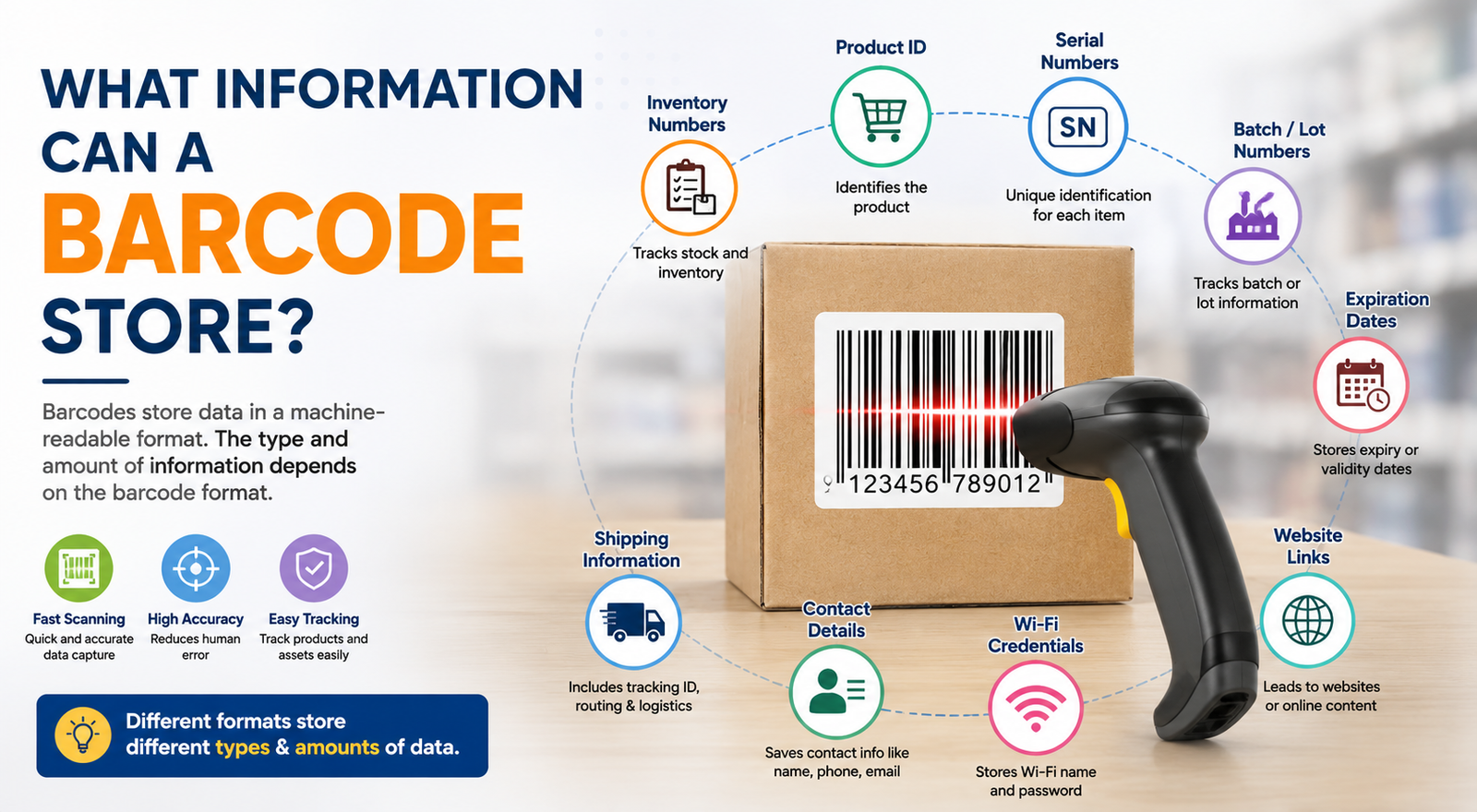
Learn what information a barcode can store, including product IDs, serial numbers, inventory codes, tracking details, and more. A simple guide for beginners.
Barcodes look simple. A few black lines, a scanner, and you're done.But those lines carry information that keeps stores, warehouses, hospitals, and shipping companies running every day.
What does a barcode actually store?
A barcode stores data in a machine-readable format.
The amount and type of information depend on the barcode format. Some hold only a product number. Others can store serial numbers, batch numbers, expiration dates, or website links.
Product identification
Retail stores use barcodes to identify products.
For example, a bottle of water might have an EAN-13 or UPC-A barcode. When it's scanned at the checkout, the store's computer finds the product name, price, and tax information from its database.
The barcode itself doesn't contain all those details. It contains a unique product number that points to them.
Inventory numbers
Businesses use barcodes to track stock.
Every item can have its own inventory code, making it easy to count products, move them between warehouses, or check what's available.
A quick scan is much faster than typing long item numbers by hand.
Serial numbers
Some products need individual tracking.
Electronics, medical devices, and industrial equipment often use barcodes to store serial numbers. If a product needs servicing or a recall, the manufacturer can identify the exact unit.
Batch and lot numbers
Food and pharmaceutical companies often print batch numbers in barcodes.
If a batch has a problem, they can find affected products quickly instead of checking every item one by one.
Expiration dates
Many healthcare and food businesses include expiration dates in barcode data.
A pharmacist can scan medicine and instantly see whether it's still safe to dispense.
Shipping information
Courier companies scan barcodes at every step.
A shipping barcode can contain a tracking number, routing information, or package ID. That's how you can follow your parcel from the warehouse to your front door.
Contact details
Two-dimensional barcodes, such as QR codes, can store contact information.
You can scan one and save a person's name, phone number, email address, and company without typing anything.
Website links
QR codes can also store URLs.
Restaurants use them for digital menus. Businesses use them for product pages, customer support, or feedback forms.
Wi-Fi credentials
Typing a long Wi-Fi password isn't much fun.
A QR code can store the network name and password. One scan connects your phone automatically.
How much information can a barcode hold?
Traditional one-dimensional barcodes store a small amount of text or numbers.
QR codes hold much more. They can store thousands of characters, depending on the amount of data and the error correction level.
Does a barcode store the product price?
Usually, no.
The barcode stores a product identifier. The checkout system looks up the current price in the store's database. That's why a store can change prices without printing new barcodes.
Frequently asked questions
Can a barcode store text?
Yes. Many barcode formats can store letters, numbers, or both. The supported characters depend on the barcode type.
Can a barcode store images?
No. Traditional barcodes can't store images. QR codes also don't store image files directly. They usually store a link to an image on the internet.
Which barcode stores the most data?
QR codes can store much more information than standard retail barcodes such as UPC or EAN.
Can two products have the same barcode?
Products of the same model usually share the same retail barcode. Individual items often have separate serial numbers for tracking.